Examiner intelligence built for trademark attorneys
Trademark Examining Attorney analytics is here.
Know your examiner's refusal rate
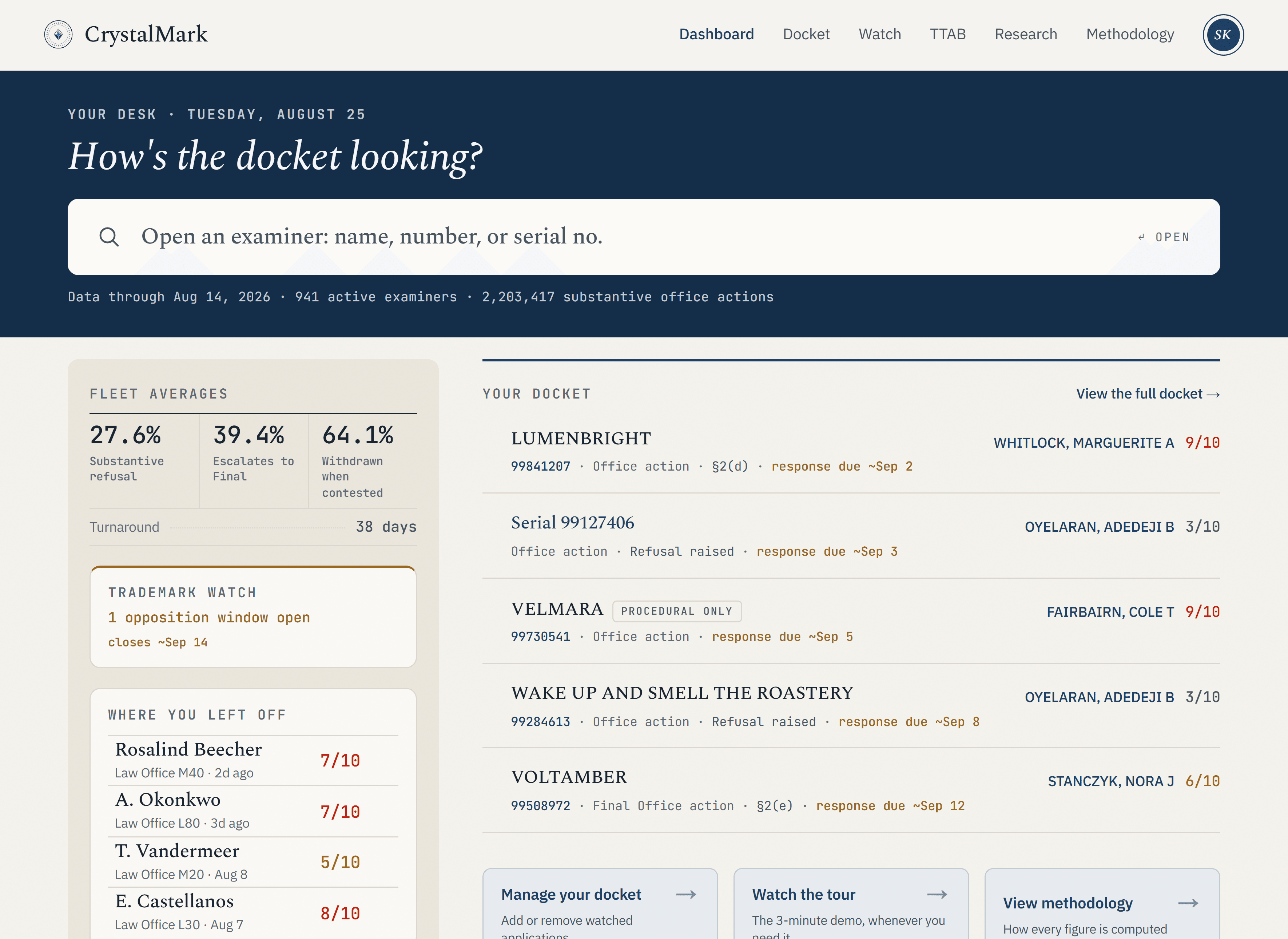
948 active examiners · 15.4M office actions · every figure from the public record
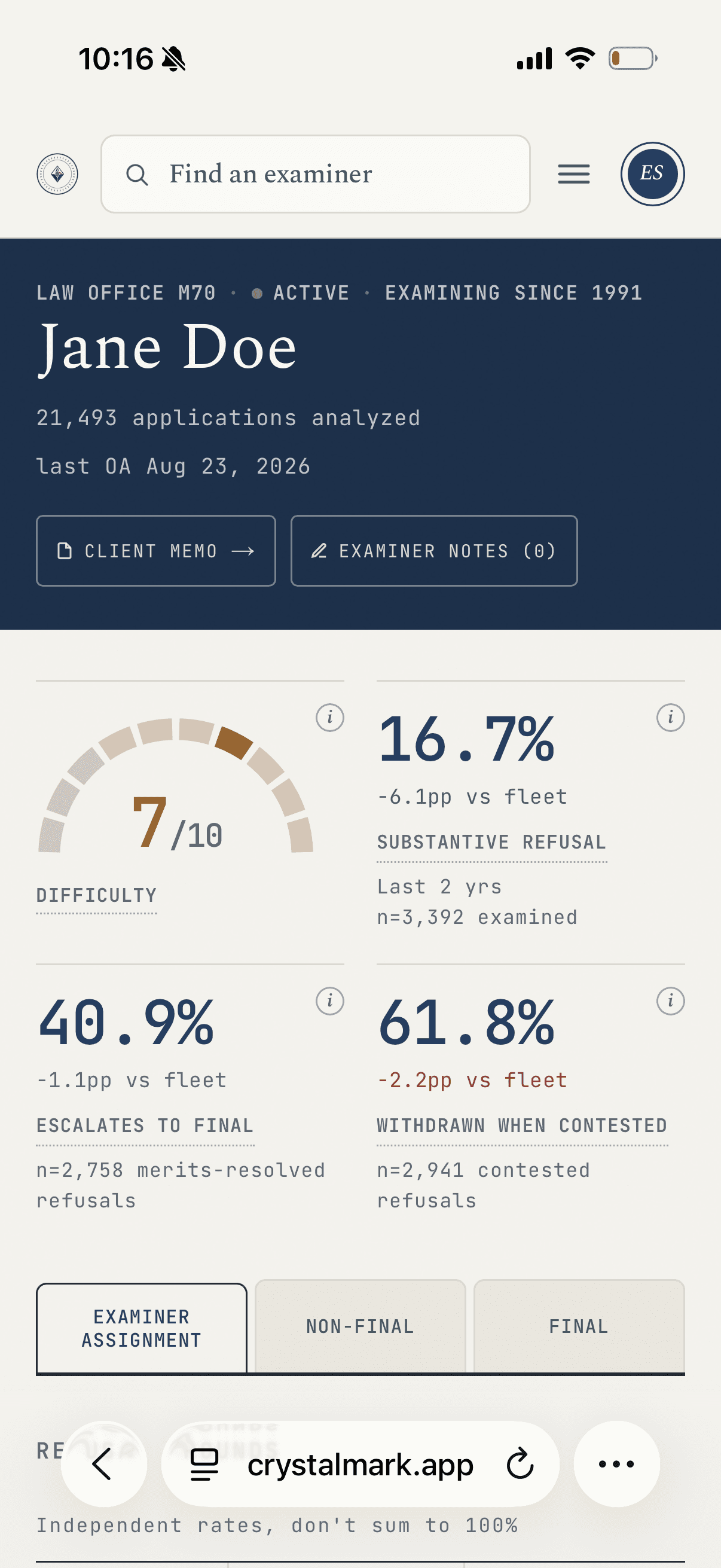
Jane Doe
Refusal mix — independent rates, an app can draw more than one
What to expect — Refuses more than most and rarely backs down at initial — but on §2(d) Finals they've been moved 31% of the time, and narrowing the goods helps most.
Will I draw a refusal?
Start with the odds. This examiner refuses more often than most — and §2(d) likelihood-of-confusion is where it concentrates.
How hard is this fight?
One number against the active fleet — how hard this examiner is to beat, not just how often they refuse. An 8 means refusals tend to stick and they rarely back down.
If I push past Final, do they relent?
Stubborn at initial isn't the whole story. Past the Final, this examiner has been moved — and how you move them is specific.
What reg are they citing — and does it give way?
The sharpest read: the specific registrations behind their §2(d)s, ranked by whether applicants have gotten past them — and the move that worked.
Jane Doe
Will I draw a refusal?
Start with the odds. This examiner refuses more often than most — and §2(d) likelihood-of-confusion is where it concentrates.
Refusal mix — independent rates, an app can draw more than one
How hard is this fight?
One number against the active fleet — how hard this examiner is to beat, not just how often they refuse. An 8 means refusals tend to stick and they rarely back down.
More difficult than ~70% of active examiners.
If I push past Final, do they relent?
Stubborn at initial isn't the whole story. Past the Final, this examiner has been moved — and how you move them is specific.
What reg are they citing — and does it give way?
The sharpest read: the specific registrations behind their §2(d)s, ranked by whether applicants have gotten past them — and the move that worked.
The §2(d) detail report ranks every cited reg on this docket
What to expect — Refuses more than most and rarely backs down at initial — but on §2(d) Finals they've been moved 31% of the time, and narrowing the goods helps most.
The gap
A case list isn't a strategy.
Other tools give you an examiner's registration rate and a list of cases. CrystalMark tells you whether you can beat this refusal— and the move that's actually worked.
What you get · Base, for everyone
The whole behavioral read,
before you respond.
Lead with breadth. Before you draft a response, read how this examiner refuses, how hard they push, and where they fold — every rate against the active fleet, every figure with its sample size.
Rates are independent — an application can draw a §2(d) anda descriptiveness refusal at once, so these don't sum to 100%. The fingerprint is what they refuse on, not a single pie.
More difficult than ~70% of active examiners.
Rarely backs down once a §2(d) is on the table — that staying power, not the 58% raw refusal rate (+21pp vs fleet), is what difficulty keys on.
Driven by how often a refusal sticks — maintained, folded, or reversed — and the rounds it takes, not just how often they refuse.
Rarely folds at the initial action — they make you earn the publication.
First office action 3.2 mo · 2.1 rounds — queue-bound timing, shown as fine print, not a selling point.
§2(d) refusal rate up ~6pp over the last three years — this examiner is getting tougher, not softer.
The window matters: a five-year average would hide the recent move.
The edge · §2(d)
Stubborn at initial.
Movable at Final — if you know the move.
The question the whole field leaves unanswered: once you're past the Final, will this examiner ever back down — and do you need a consent, or can you get there without one?
of their §2(d) Finals were withdrawn on reconsideration.
Will they move? Yes — about a third of the time, even after a Final.
were withdrawn without needing a coexistence agreement.
Do you need a consent? Not always — nearly one in five came down without one.
were withdrawn when the goods were voluntarily narrowed.
Does narrowing help here? Yes — 41% vs a 31% baseline (n=34). Cut the overlap.
Recent window · n = 142. Framed at the application level — we don't fabricate per-move success bars.
A secondary read · all-time
What happens if you appeal.
A read nobody else frames: when applicants took this examiner to the Board, how did it end? A thin, all-time sample (n=11) — and some appeals resolve on procedure, not the merits — so read it as posture, not a scoreboard. Of the 11 —
The examiner conceded more often than they won — directional leverage when you're weighing an appeal, not a guarantee (some of these ended on procedure, not the merits).
All-time totals — kept distinct from the recent-window rates above, which is the number you actually respond against.
The coverage
We already have your examiner.
Every active USPTO trademark examiner is already in our index. Find yours — the public page is open to anyone; the behavioral read is what you unlock.
The public page is open to anyone — the full behavioral read unlocks with a plan.
Honest proof
Every figure traces to the public USPTO record.
Verify it yourself.
We're new — est. 2026 — so we don't ask you to trust a quote. Each number is computed from the public file history, against an active-fleet benchmark, with the sample size shown.
Built on public record
Every figure is computed from the public USPTO file-wrapper history — attorney↔examiner office actions and TTAB cases. Nothing private.
Every number is checkable
Click any figure to see the applications, office actions, and cases behind it. Provenance, not a number you take on faith.
Sample sizes shown, honestly
Every rate carries its n and window. On a thin examiner we say "Based on 41 §2(d) actions — read directionally" rather than fake precision.
Active-fleet benchmarks
"Harder than 70%" is measured against the examiners taking cases today — not an all-time average that flatters the number.
No testimonials. No logo wall. No invented success stats. The credibility play is verifiability.
Your client's refusal
isn't unbeatable.
See the moves that worked on this examiner.